OEM Face Lift HIFU Machine: Private Label Guide
An OEM face lift HIFU machine is a professional ultrasound platform built by the factory and sold under your brand, with the manufacturer owning production, tooling and quality control. The branding on the panel changes who owns the customer relationship, not the physics inside the handpiece. This guide walks through what a private-label HIFU program actually involves, from cartridge depth selection and customization tiers to MOQ, tooling, paperwork and the post-launch cartridge pipeline.
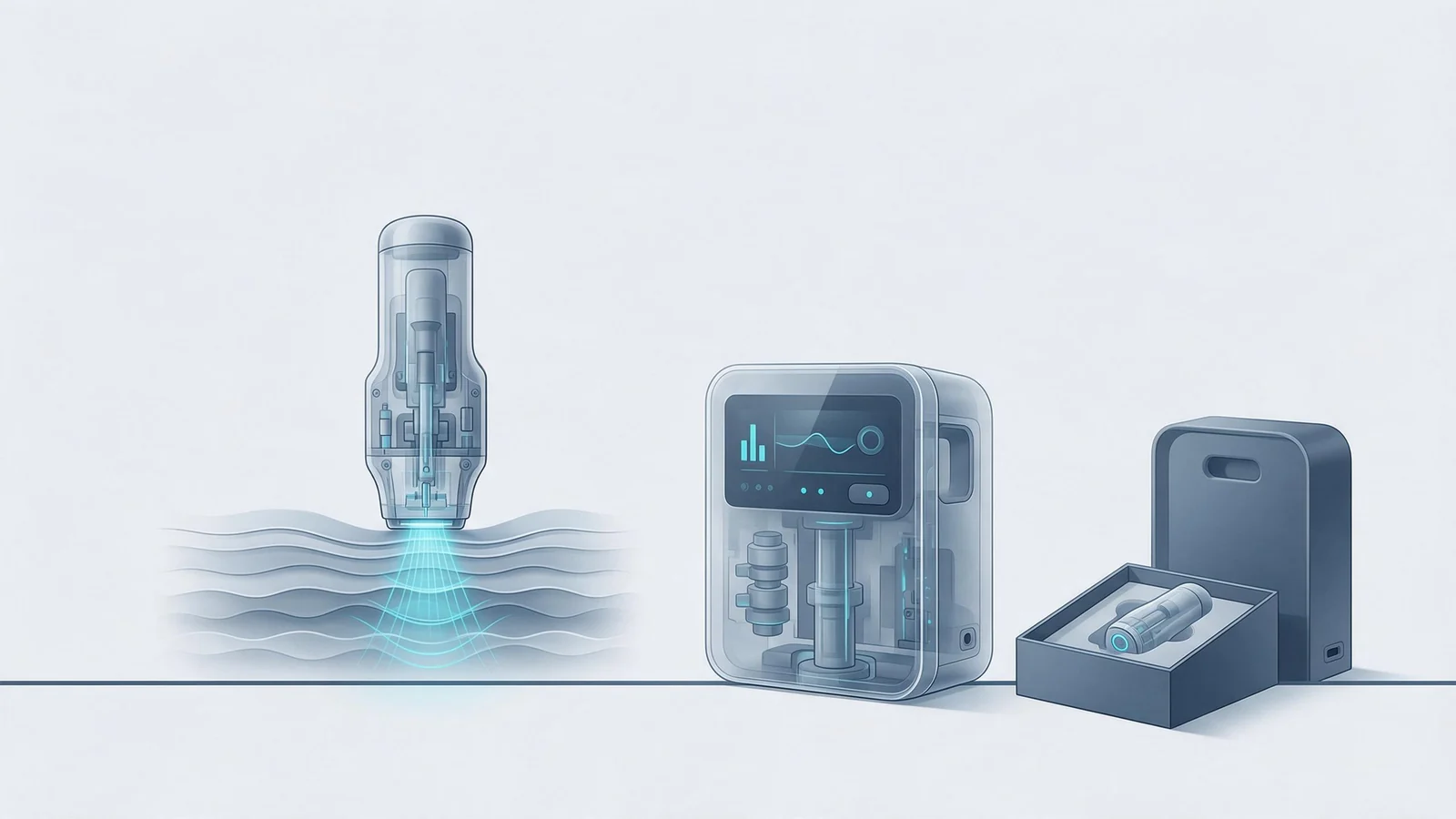
An OEM face lift HIFU machine is a professional ultrasound platform built by the factory and sold under your brand, with the manufacturer owning production, tooling and quality control. That's the whole definition. Your logo goes on the housing, your name goes on the nameplate, and the ultrasound engine underneath stays exactly the same as the unit the factory sells to anyone else. It's a rebrand, not a redesign.
Buyers confuse OEM with ODM constantly. OEM means you take an existing platform and put your identity on it. ODM means you ask the factory to modify something structural, a new housing mould, a reworked software interface, a different handpiece shell, and that pushes you into a development project with tooling cost and a much higher minimum order. If you're a clinic owner adding your own label to a device you already trust, you want OEM. If you're a distributor building a catalogue and you need a shape nobody else has, you want ODM, and you should budget accordingly.
Here's the part that gets skipped in every glossy brochure. Branding does not change the regulatory status of the device in your market. A HIFU platform that requires registration in your country requires it whether the panel says your name or the factory's. Your logo is a commercial mark, not a compliance document. This is educational material for equipment buyers, not medical advice, and nothing here should be read as a promise that any device will be cleared for sale where you operate.
The HIFU Platform You Are Rebranding: Handles, Cartridges and Depths
Before you discuss logos, you need to know what you're actually ordering. Our HF-01 is the platform most private-label conversations start from, and the spec is public on the HF-01 HIFU page. Treatment handles are a 4D Handle, a V-max Handle, and an optional Vaginal Handle. The 4D Handle cartridges are 3.0mm and 4.5mm, with optional 16mm, 13mm, 10mm, 8mm and 6mm. The V-max Handle cartridges are 1.5mm, 3.0mm and 4.5mm, with optional 8mm and 13mm. The Vaginal Handle cartridges are 3.0mm and 4.5mm. Output frequency is 4-7MHz, output voltage is 10-200W, and the screen is a 10 inch touch screen.
Why does depth matter so much at the ordering stage? Because depth determines which tissue layer the cartridge is built to reach, and that determines what your market actually books. A clinic doing facial lifting wants the 4.5mm and 3.0mm 4D cartridges as the core of the order. A clinic adding neck and body work needs the longer optional depths. A distributor supplying a mixed customer base usually carries a broader cartridge spread and accepts a larger opening order to get it.
Cartridge configuration is one of the few things a buyer genuinely chooses at order stage. Everything else is either fixed or a customization tier you pay for. So spec your cartridge mix deliberately, not as an afterthought bolted onto the logo discussion.
What Can Be Customized: Logo, Housing, Software and Packaging
Think of customization as three tiers, and each tier costs more and takes longer than the one below it.
Label level. Logo on the housing, a nameplate with your company name, a boot screen with your brand. These are the cheapest changes and the fastest to execute. You supply vector artwork, the factory supplies the print or the badge.
Software level. UI language, preset protocols tuned to your market's typical treatment menus, a start-up screen with your brand identity. This requires engineering time on the firmware, so expect a setup charge and a longer approval loop.
Hardware level. Housing colour, handpiece shell, custom packaging. This is where tooling enters the picture. A new housing mould carries tooling cost and a materially higher MOQ than any label-level change, because the factory has to cut a mould and amortise it across your order.
What is not customizable, ever, without becoming a new development project: the internal platform, the cartridge geometry, and the energy delivery. Those aren't cosmetic. Changing any of them means you're building a different device, and the paperwork, testing and timeline all reset.
One warning worth repeating. Any customization that touches the nameplate or the certification label needs your own regulatory paperwork in place first. If your market requires the legal manufacturer to be named on the device, that name has to be correct before the plate is printed, not after. Sort the regulatory position before you approve artwork, because reprinting a batch of nameplates is expensive and reworking a shipped batch is worse.
MOQ, Tooling and Cost Structure: How an OEM Quote Is Built
A quote breaks into four pieces: unit cost, one-time tooling or artwork setup, cartridge supply, and freight. Each is quoted per configuration. That last phrase matters more than any number, because there is no single OEM HIFU price. A label-only order and a new-housing order are different products with different economics.
MOQ is set by the customization tier, not by one flat figure. Label-level orders start far lower than new-housing orders. If a supplier quotes you a flat MOQ regardless of what you're asking them to change, that's a signal they haven't actually costed your request.
Here's the trap. When you compare two suppliers, a lower unit price almost always hides a thinner cartridge package or a reduced handle set. Ask for a written configuration sheet from each supplier before you compare anything. Line up the handles, the cartridge depths and counts, the screen, the packaging, and the warranty text side by side. Only then does the unit price mean something.
We quote per configuration. Request a configuration-based quote rather than working from a list price, because the list price for an OEM HIFU platform doesn't exist in any meaningful form.
Certification and Regulatory Transfer: What the Factory Hands Over and What You Must Register
This is the section most buyers read last and should read first. Registration in your market is normally held by you or your local importer, not by the Chinese factory. The factory can hand over documents. It cannot register a device in your country on your behalf.
So ask any supplier for the same document set, every time: electrical safety and EMC test reports, ultrasound class documentation, a declaration of conformity, and a technical file you or your consultant can review. In this product family, our own device manuals record that a laser system is classified as a Class 4 laser device by national devices and radiation health authorities. That's the kind of classification documentation you should be asking to see, for lasers and for ultrasound platforms alike. The IEC standard that governs ultrasonic physiotherapy equipment, IEC 60601-2-5:2009, was published on 2009-07-30 as edition 3.0, and it amends and supplements IEC 60601-1 including Amendments 1 and 2. That's the sort of standard reference a serious supplier should be able to discuss without hesitating.
Say it plainly: we do not hold a named certification for the HF-01, and no certificate number is recorded for this model. Any supplier who hands you a certificate should be verified directly with the issuing body, by you, using the number on the document. Don't accept a PDF as proof. Confirm with the issuer.
Confirm with your own regulatory consultant which approvals your market requires before you place an order. That's not a formality. It determines whether your nameplate text is legal, whether your packaging claims are legal, and whether you can sell the unit at all.
Sample, Tooling, Pilot Run, Mass Production: The OEM Timeline Step by Step
Here's the flow, stage by stage, with what you owe at each gate.
- Requirement brief. You supply the target market, the treatment menu, and the customization tier you want. The factory supplies a feasibility read.
- Configuration sheet and quote. Handles, cartridges, screen, packaging, customization scope and MOQ, all written down. You approve the sheet before anything moves.
- Brand artwork approval. You supply logo files, label artwork and any regulatory text that must appear on the device. Approve this in writing.
- Sample or pilot unit. The factory builds one unit to your approved spec. You physically inspect it.
- Buyer sign-off. You approve the sample in writing. This is the gate that protects you.
- Mass production. Runs against the approved sample and configuration sheet.
- QC and packing. The factory tests and packs. The HF-01 package dimension is 20*40*54cm and gross weight is 11kg, base not included.
- Shipment. You supply the shipping address and the agreed incoterm.
Approve a physical sample before tooling is cut. Always. If the sample is rejected, the loop restarts at artwork or configuration, and nothing has been cut yet, which is exactly where you want to be. Lead time depends on the customization tier and the cartridge configuration, so it's confirmed on the quote, not published on a website.
Consumables, Training and Support After the First Order
Cartridges are the recurring cost of a HIFU program. The HF-01 uses replaceable cartridges in the depths listed in the spec table, and that's your revenue line after launch and your expense line too. Agree shot lifespan, reorder lead time, and whether cartridges can carry your brand, in writing, before the first order ships. Shot count and cartridge pricing aren't published here because they're configuration-dependent, so confirm them per supplier.
Ask any supplier what training is delivered, in what format, and whether it covers treatment protocols or only machine operation. Those are very different products. Protocol training is what your clinic staff actually need on day one. Machine operation training tells them which button does what and nothing about who to treat.
Ask for the written defect and spare-parts policy instead of a verbal promise. Our RF-01 platform is listed with a 12-month warranty and lifetime maintenance, and you can see that on the RF-01 RF skin tightening page. No warranty terms are recorded for the HF-01, so confirm the written policy per model with whoever you buy from. A private-label program only makes money if the cartridge pipeline is reliable after launch. Everything else is a one-time sale.
Supplier Vetting Checklist for OEM HIFU Buyers
Copy this and take it to every conversation.
- Business licence and exact legal entity name. Not a trading name. The legal name.
- Factory address you can verify independently.
- Named certification numbers you can validate directly with the issuing body.
- Cartridge test data, not a brochure claim.
- Referenceable export history.
- Written configuration sheet listing handles, cartridge depths and counts.
- Written defect and spare-parts policy.
- Clear answer on who holds registration in your market.
- Clear answer on whose name appears on the nameplate.
- Serial-number traceability on every unit.
Red flags: refusal to name the legal manufacturer, no serial-number traceability, pressure to pay tooling before a sample is approved, and vague certification claims that never produce a number. If a supplier can't tell you who the legal manufacturer is, that's not a paperwork gap. That's the answer.
For a deeper set of questions, work through our HIFU supplier vetting guide before you shortlist anyone.
FAQ
Which HIFU machine brand is best for professional use?
There's no single best brand, and any supplier telling you otherwise is selling. What matters for professional use is whether the platform's cartridge depths match your treatment menu, whether the factory can name its legal entity and show test documentation, and whether cartridge supply is reliable after launch. Compare configuration sheets, not brand names.
What is the best brand of HIFU?
The honest answer is that brand reputation is a proxy for the things you can actually verify: documented test reports, traceable serial numbers, a named legal manufacturer, and a cartridge pipeline that holds up. Ask every supplier for those four things. The one that answers clearly is the better brand for your clinic.
How much does a HIFU machine cost?
Cost depends entirely on configuration: handles, cartridge depths and counts, screen, packaging and customization tier. There is no meaningful list price. Request a written configuration sheet and a per-configuration quote, because a low unit price usually hides a thinner cartridge or handle package.
What does an OEM face lift HIFU machine cost and what drives the price?
Four things drive an OEM HIFU quote: unit cost, one-time tooling or artwork setup, cartridge supply, and freight. MOQ is set by the customization tier, so label-level logo and boot-screen orders start far lower than orders requiring a new housing mould. We quote per configuration, so ask for a configuration-based quote rather than a figure.
Evidence and further reading
Educational material for equipment buyers and operators. It is not medical advice, an operating protocol or a promise of clinical outcome.
Keep reading
Ready to spec your next machine?
Tell us the indication, your market and the certifications you need. Our export team replies with a configuration and quotation within 12 to 24 hours.