pmisetech@gmail.com  ·  +86 133 2121 6666 FDA / CE / RoHS / SGS certified
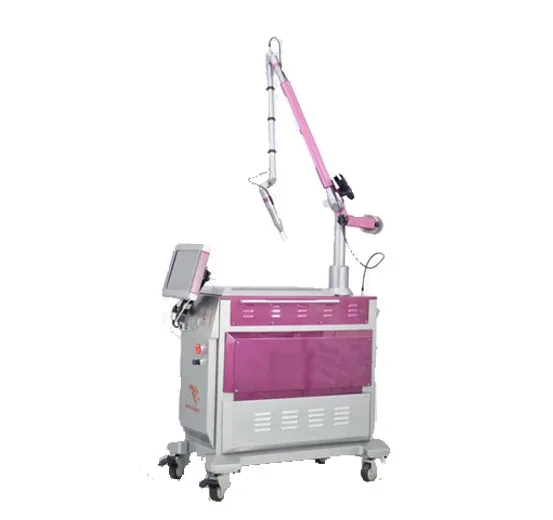
Pmise QE-01 EO Q-Switched Nd:YAG, 1064/532nm
Q-Switched Nd:YAG Laser

Pmise QE-01

EO Q-switched Nd:YAG laser, 1064/532nm

QE-01 is the pigment and tattoo platform: an EO Q-switched Nd:YAG delivering 6-nanosecond pulses at 1064 and 532nm, with up to 800mJ at 1064nm. It is the machine behind tattoo removal services, and the one our distributors place most often into dermatology clinics.

The spot adjusts continuously from 1 to 7mm, which matters more than buyers expect: small spots preserve fluence for deep ink, large spots speed up epidermal pigment work.

How it works

A Q-switch stores energy in the laser cavity and releases it in a single 6-nanosecond burst. At that timescale the pulse is shorter than the thermal relaxation time of tattoo ink particles and melanosomes, so they are shattered photoacoustically before surrounding tissue meaningfully heats. The fragments are then cleared by the body's own scavenger cells over the following weeks.

The two wavelengths split the work by depth and colour. 1064nm penetrates deeper and is absorbed poorly by epidermal melanin, making it the safe choice for dermal pigment: black and blue ink, nevus of Ota, dermal melanocytosis. The 532nm frequency-doubled line is absorbed strongly near the surface, where it clears red and warm-toned inks and epidermal lesions like freckles. This is selective photothermolysis applied at nanosecond scale.

Applications

  • Tattoo removal across ink colours: 1064nm for black and blue, 532nm for red and warm tones
  • Nevus of Ota and dermal pigmented lesions with 1064nm, sessions spaced months apart
  • Freckles, lentigines and epidermal sun spots with 532nm
  • Laser toning protocols for pigment management under medical supervision

Key advantages

  • Genuine EO Q-switch at 6ns, not a long-pulse imitation marketed as tattoo removal
  • 800mJ at 1064nm and 400mJ at 532nm, enough for dense professional ink
  • Spot size 1-7mm continuously adjustable to hold fluence at depth
  • 1-10Hz repetition for practical session times on large pieces
  • 7-joint articulated arm with a balanced handpiece for precision work
  • Dual-voltage supply for 220V and 110V markets

Specification

Laser TypeEO Q-switched Nd:YAG laser
Wavelength1064nm, 532nm
Maximum Energy800mJ (1064nm); 400mJ (532nm)
Pulse Width6ns
Frequency1-10Hz
Spot Diameter1-7mm continuously adjustable
Beam Delivery7-joint arm
Power SupplyAC 220V 50Hz; AC 110V 60Hz
Net Weight65kg

Frequently asked questions

How many sessions does a tattoo need?

Amateur black tattoos often clear in a handful of sessions; dense professional work, multicolour pieces and resistant inks take more, sometimes many more. Sessions sit six to eight weeks apart to let the body clear fragments. Any supplier quoting a fixed number before seeing the piece is guessing, and we say so to your clients in our training material.

Does it hurt, and what is the downtime?

Clients describe the sensation as rapid hot snaps, and most clinics manage it with air cooling and, where permitted, topical anesthetic. Expect pinpoint whitening immediately, then redness and possible pinpoint bleeding for a few days. There is no ablative wound of the kind a CO2 platform creates.

Is it safe on darker skin?

1064nm is the safest pigment wavelength for dark skin because epidermal melanin absorbs it weakly, but conservative fluences and test spots remain mandatory on Fitzpatrick IV-VI. The 532nm line is for light skin only.

What should I check when comparing Q-switched machines?

Ask three questions: what is the true pulse width (single digits of nanoseconds is the answer you want), what is the maximum energy at 1064nm, and is the Q-switch EO or a passive dye cell. The answers separate genuine platforms from long-pulse machines sold on a tattoo-removal promise they cannot keep.

Ready to spec your next machine?

Tell us the indication, your market and the certifications you need. Our export team replies with a configuration and quotation within 12 to 24 hours.