Reading Fitzpatrick Skin Types Before You Treat
Fitzpatrick skin types grade how skin reacts to ultraviolet light, not how dark it looks, and that phototype sets your wavelength, pulse width, fluence selection and cooling before the first pulse. Read it wrong and the client pays in pigment weeks later. A conservative first session and a test spot protect the skin and the clinic at the same time.
What the six types actually measure
Fitzpatrick skin types don't grade colour. They grade behaviour. The scale asks two questions about a person's history under ultraviolet light: do you burn, and do you tan? Fitzpatrick wrote the first version in 1975 to set starting UVA doses for psoralen photochemotherapy; types V and VI came later, in the 1988 Archives of Dermatology paper operators quote. A dosing tool, never a pigment meter.
- Type I always burns, never tans
- Type II burns easily, tans minimally
- Type III sometimes burns, tans gradually
- Type IV burns minimally, tans easily
- Type V rarely burns, tans deeply
- Type VI never burns, deeply pigmented
Type the client, not the market. Clinics in Bangkok still meet Type II clients.
Where the scale lets you down
Three failures show up in real appointment books, and they don't all point the same way.
The tanned Type II. Sun exposure moves the epidermis without moving the paperwork. The recorded phototype ends up lighter than the skin is behaving, and that's the burn direction: Type III energy into an epidermis loaded with fresh melanin, then a blister or pigment weeks later. Re-screen at every visit.
Mixed heritage. The chart bundles hair colour, eye colour and ancestry with burn history, and those bundles come apart constantly. This one errs either way: a client who reads as Type III can burn like a Type II or tan like a Type V. Drop the descriptors, ask the two original questions.
Self-report drift. A 2024 single-centre survey of 472 dermatology patients found participants reporting more burning and tanning than their provider-assigned type implied, a gap the authors read as providers underestimating patients' ability to sunburn. That one runs the other way: the type in the file is more sun-tolerant than the client's own history supports. On energy it's forgiving, since you land in a conservative column and pay in a flat result rather than a burn. Aftercare is where it bites. Someone filed as burn-resistant gets under-pitched sun-avoidance advice, and sun on freshly inflamed skin is a reliable route into PIH.
One rule holds whichever way the error points. When the type is uncertain, set energy from the darker column, counsel the client as though they burn easily, and let a test spot settle it.
Melanin is the competing chromophore
Epidermal melanin absorbs light you meant for something else. Every joule it takes never reaches the follicle, the vessel or the tattoo particle. Anderson and Parrish set the framework out in Science in 1983: suitably brief pulses of selectively absorbed radiation damage pigmented structures while sparing what surrounds them, the target's own optical and thermal properties doing the aiming. More in our note on selective photothermolysis and how pulse duration protects surrounding tissue. On light skin that window is wide, on dark skin narrow.
What phototype changes on each platform family
Wavelength. Move longer. Epidermal melanin absorbs 1064 nm comparatively weakly, which makes it the safe default for darker skin on the QE-01 EO Q-switched Nd:YAG platform with dual 532 and 1064 nm output; our manual for it assigns 532 nm to types II and III at a 3 mm spot or larger, 1064 nm from Type III up. StatPearls agrees: longer wavelengths for skin of colour. Preference isn't prohibition, though. Our hair-removal training material treats 600 to 1200 nm as the ordinary working band and answers types IV to VI with longer wavelength, longer pulse, reduced energy and active cooling together. The DL-07 808 nm diode platform for hair removal across phototypes sits inside that band and stays usable on Type V skin when those four travel together.
Pulse width. Lengthen it. A longer pulse lets the epidermis shed heat sideways while a bigger, slower-cooling target keeps accumulating damage. Our diode manual runs 5 to 200 ms. Safety bought with time, not energy.
Fluence selection. Start under the textbook number. Our IPL parameter sheet: lowest listed setting, titrate on reaction, and anyone between Type IV and Type V works from the V column.
Cooling. Not optional above Type III. Our diode manual wants the chiller on and five to eight minutes gone, at 18 degrees C, before pulse one. Skip the wait and your cooling system isn't cooling.
| Control | Types I to III | Types IV to VI | Source |
|---|---|---|---|
| Wavelength | 532 nm for superficial pigment, 3 mm spot minimum; 600 to 1200 nm in use | Prefer longer. 1064 nm the default for Q-switched work; 532 nm stays with II and III; 808 nm diode still usable with long pulses, reduced energy and cooling at setpoint | Our Q-switched manual; our training material; StatPearls |
| Pulse width | Short end of the 5 to 200 ms range | Long end, output energy reduced with it | Our diode manual; StatPearls |
| Starting fluence | Lowest listed number, then titrate | Lowest number; clients between IV and V start from the V column | Our IPL parameter sheet |
| Epidermal cooling | Standard contact cooling | Active cooling every pass, chiller at setpoint first | Our diode manual; StatPearls |
| RF surface temperature | 40 to 48 degrees C, measured | 40 to 45 degrees C from Type III up | Our IPL and RF platform manual |
Commissioning a platform into a Type IV to VI book? Ask us for its phototype parameter tables before you write the protocol, not after the first complaint.
PIH is the risk that follows you home
Burns are loud and immediate. PIH risk is quiet, lands weeks later, and costs clinics their reputation in Type IV to VI markets. Post-procedural hyper- and hypopigmentation are likelier in types IV through VI, and a 2023 review keeps lasers second line to topicals for PIH in skin of colour: variable response, cost, complications.
Grade the pigment as well as the phototype. Our skin science training material runs P0 to P3, and the ends behave differently: at P1, light patches over under a quarter of the face, inflammation rarely leaves pigment behind; at P3, heavy dark pigment over more than a third, it readily does and clears slowly. Two clients can share a Fitzpatrick number and sit at opposite ends of it.
Our skin disease atlas is blunt about mechanism: strengthened melanocyte activity in the basal layer, inflammation control as the primary treatment, more pigmentation listed as a complication of treating it. What lowers the risk is unglamorous:
- A deliberately gentle first session, run as calibration, not as a result
- Priming with a clinician-prescribed topical regimen; hydroquinone before and after treatment is documented to reduce PIH risk around resurfacing
- Strict photoprotection either side of the appointment
- Longer intervals in darker phototypes; delayed pigment can't be read at seven days
- Stopping at the first grey-white change, pinpoint bleeding or blistering
Melasma punishes assertive settings
Melasma is where confident operators do the most damage. It flares under settings ordinary sun spots absorb without complaint, then returns.
Published practice runs deliberately timid. A 2022 systematic review of low-fluence Q-switched Nd:YAG toning describes 1064 nm at roughly 1 to 3 J/cm2, a 6 to 10 mm spot, around ten sessions weekly or fortnightly. The rest of that literature is sobering: one series of 177 patients reported mottled hypopigmentation in about 12 percent, and three-month recurrence ran to 64 and 81 percent in two studies. Manage melasma as a recurring condition, never as a course that ends.
Diagnosis belongs to a clinician. Melasma, post-inflammatory pigment and lesions needing a dermatologist's eye look alike across a consultation desk. Our atlas warns against ablative resurfacing above Fitzpatrick III, a sound default for any pigment you can't name. When in doubt, refer.
The test spot, written as a protocol
A test spot costs ten minutes. A PIH case costs a client, a refund and a review.
- Trigger. Every client typed IV or above, every recent tan, every new indication, every handpiece change.
- Site. A discreet area inside the intended zone, matched for skin thickness and hair density. Photograph it first.
- Ladder. Three to five pulses at ascending settings from the lowest number in the type column, spaced far enough apart to read separately.
- Immediate read. Perifollicular oedema and mild erythema are the endpoints. Grey-white change, blistering or wheals mean stop.
- Delayed read. Review at the interval your protocol sets, long enough in types IV to VI to catch delayed pigment, not day-one redness.
- Decision. Take the highest setting with a clean endpoint and no delayed pigment, then drop one step for the first session. You can always climb.
- Record. Every setting, reading and photograph, in the client file.
Consent, documentation, and where to go next
The clinical file is the legal one too. When a complication arrives, nobody asks whether you're a good operator. They ask what you can show. Keep the assigned phototype and who assigned it, screening answers on sun exposure, self-tanning, photosensitising medication and pigment history, the test spot readings, dated photographs at a consistent distance and light, every parameter from every session, and a consent form naming PIH, hypopigmentation, blistering and scarring in language the client read. Record refusals too. A client who declines a test spot and insists on treating today is a documented decision, not an argument from memory.
Your next step. Running the treatment room? Name your platform and the phototypes that dominate your book, and ask for its type-column parameter tables and starting-fluence sheets, plus the ladder above as a test spot SOP you can edit for staff. Distributors: ask for the same set in the handover training pack, in your clinics' training language, and an applications call to build the protocol with your first accounts. Tell us your platform and phototype mix, and say which of the two you are.
Evidence and further reading
Educational material for equipment buyers and operators. It is not medical advice, an operating protocol or a promise of clinical outcome.
- Anderson RR, Parrish JA. Selective photothermolysis: precise microsurgery by selective absorption of pulsed radiation. Science, 1983;220(4596):524-527
- Fitzpatrick TB. The validity and practicality of sun-reactive skin types I through VI. Arch Dermatol. 1988;124(6):869-871
- Laser Fitzpatrick Skin Type Recommendations. StatPearls, NCBI Bookshelf
- Fitzpatrick Skin Type Self Reporting Versus Provider Reporting: A Single-center, Survey-based Study. Journal of Clinical and Aesthetic Dermatology, 2024;17(12):18-22
- The Low-Fluence Q-Switched Nd:YAG Laser Treatment for Melasma: A Systematic Review. Medicina (Kaunas), 2022;58(7):936
- Review of Laser Treatments for Post-Inflammatory Hyperpigmentation in Skin of Color. American Journal of Clinical Dermatology, 2023
Put it to work
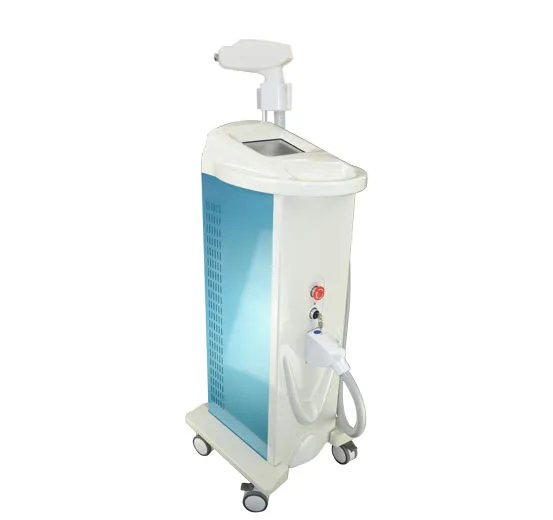 The machine that fitsPmise DL-07
808nm Diode Laser Hair Removal Next noteSelective Photothermolysis, Explained Properly
The 1983 Anderson & Parrish principle every aesthetic laser and IPL relies on: chromophores, thermal relaxation time, and why pulse width matters as much as wavelength. CatalogAll platforms
Twelve machines, one factory standard, full specifications.
Ready to spec your next machine?
Tell us the indication, your market and the certifications you need. Our export team replies with a configuration and quotation within 12 to 24 hours.