IPL vs Laser: How to Choose for Your Clinic
IPL vs laser isn't a contest between a good technology and a bad one. It's a question about your treatment menu, the skin types walking through your door, and the arithmetic of cost per treatment. Get the physics right and the buying decision mostly answers itself.
What a laser gives you
A laser is light with discipline: one wavelength (monochromatic), waves marching in step (coherent), traveling in a near-parallel beam (collimated), and able to focus to extremely high energy density. Those four properties are not vanity. Monochromaticity is what makes selective photothermolysis possible, because the beam can be tuned to one chromophore and mostly ignored by everything else.
The cost of that discipline is narrowness. An 808nm diode laser removes hair superbly and does almost nothing else. A Q-switched Nd:YAG shatters pigment and ink and little more. Precision is the product.
Anderson and Parrish set the rule in 1983 in Science. Brief pulses of selectively absorbed light damage pigmented structures without careful aiming, they showed, because the optical and thermal properties of the target do the aiming for you. Every machine on your shortlist is a commercial answer to that one idea.
What the xenon flashlamp actually emits
Intense pulsed light starts from the opposite philosophy. A xenon flashlamp does not choose a wavelength; it discharges a broadband composite spanning ultraviolet, visible and infrared, and the optics downstream decide what survives. That is the whole trick, and it is also the whole problem.
Two pieces of glass do the work. Our device manuals specify a dual filtration design, a special UV tube plus a cut-off filter, that strips everything below 400nm so no ultraviolet reaches the skin. Cut-off filters are high-pass: quote one as 610-1200nm and you're really being told that light below 610nm is blocked. Swap the filter, swap the indication. 610-1200nm for hair reduction, 530-1200nm for photorejuvenation, 585-1200nm for vascular work, 560-1200nm for pigment, 430-1200nm for acne care.
The upper figure deserves less trust than the lower one. Nobody stacks a hard edge at 1200nm; that number describes where lamp output, glass transmission and water absorption have already thinned the beam out. Read the first number. Treat the second as scenery.
What broadband costs you
Selectivity is a ratio, not a switch. When a pulse carries hundreds of nanometres of spectrum instead of one, a good share of the delivered joules lands on chromophores you weren't aiming at, and the biggest bystander is epidermal melanin. Our light-tissue interaction notes put the skin's optical window at 600-1200nm, where scattering is low and absorption by endogenous pigments is limited. Filtering the short end pushes IPL toward that window. It never gets you all the way there.
Here is the number that makes the point. In our engineering archive there's a worked hair-removal example: at a given fluence, a melanin-loaded follicle takes about 100ms of progressive coagulation, while the epidermis under the same beam is damaged at about 99ms. One millisecond of margin. That is why contact cooling at the sapphire tip is structural rather than a comfort feature, and it is also why fluence headroom on a broadband platform is smaller than the spec sheet implies. You are not limited by what the lamp can produce. You're limited by what the epidermis will tolerate on the way through.
The clinical consequence is skin-type range. Darker and tanned skin gives the beam more competing melanin at the surface, so operators drop fluence, lengthen the pulse, choose a longer cut-off, and accept slower progress. Post-inflammatory hyperpigmentation is the failure mode to fear here, and it punishes optimism. Test spots and conservative settings are not caution theatre.
E-light platforms buy back part of that margin. Adding bipolar RF to the pulse heats the dermis without regard to skin colour, which lets the optical component run at lower fluence and stretches IPL further into tanned and darker clients. It does not repeal the risk.
Spot size, coverage rate and the clock
Session time is a spot-size problem before it's anything else. Larger spots penetrate deeper and spread energy more evenly at a given wavelength, which is why IPL treatment windows are big rectangles rather than dots. Then the flash rate takes it back.
| MF-05 (IPL and RF) | DL-07 (808nm diode) | |
|---|---|---|
| Emission | Filtered broadband, 430-1200nm bands | Single wavelength, 808nm |
| Spot | 60x15mm (9cm²) or 8x40mm (3.2cm²) | 13x15mm (1.95cm²) |
| Energy density | up to 50J/cm² | 2-80J/cm² |
| Pulse width | 0.1-10ms, sub-pulses with adjustable intervals | 5-200ms |
| Delivery rate | Flash interval set in the 3-5s band | 1-10Hz |
| Coverage rate on paper | roughly 2-3cm² per second | close to 20cm² per second at 10Hz |
| Main optical consumable | Xenon lamp, rated 60,000 flashes | No flashlamp to replace |
Both coverage figures are arithmetic, not clinical throughput. Our operating manuals ask the operator to overlap each spot onto about a third of the previous one, and a sliding diode pass behaves differently from stamped IPL flashes. Even after you haircut them, the gap is big enough to reorganise a treatment room. A full back is a different appointment on each platform.
Cost per treatment, which is the number that decides
Clinic economics live in the consumables, and IPL has a real one. Our maintenance documentation rates the xenon lamp at 60,000 flashes, with an explicit warning attached: at the high settings hair removal demands, clinical effect drops off around 30,000 flashes and the operator has to raise energy to compensate. Read that twice. For hair work, budget against roughly half the nameplate life.
So build the model honestly. Take the lamp price, add handpiece service and the days the room is dark, divide by the flashes you'll actually get at your working fluence, then multiply by the flashes a session consumes. Add coupling gel, which our manuals treat as a light-guiding and cooling medium rather than an optional extra. That total is your cost per treatment, and it belongs next to your price list before you sign anything.
A diode platform moves those costs elsewhere. No flashlamp sits in the chain, so recurring spend is cooling water and preventive service rather than a wear part with a shot counter. Higher entry price, flatter running cost, and payback depends entirely on how many hours a week it's switched on.
The case mix that earns each machine its place
Hair removal is the cleanest comparison, and the published evidence is unflattering to broadband light. Haedersdal and Wulf's evidence-based review found support for partial long-term hair reduction beyond six months after repeated alexandrite and diode laser treatment, and concluded that evidence was lacking for long-term hair removal after IPL. A 2022 systematic review of five randomised trials covering 223 patients found diode reductions spanning 32.5 to 69.2 percent, with the best results on body sites with the longest growth cycles. Small evidence base, wide spread, consistent direction. If hair removal is your headline service, buy the DL-07 808nm diode laser and stop deliberating.
Pigment and tattoos belong to the Q-switched laser, full stop. No IPL pulse shape matches nanoseconds, and our QE-01 exists for exactly that reason. Resurfacing belongs to the fractional CO2 laser, which is what CF-01 is for. Discrete vessels want a laser too.
Now the other side of the ledger. Photorejuvenation, diffuse redness, freckling and mixed sun damage are where an MF-05 E-light platform genuinely earns its keep, because the targets are scattered across several chromophores and depths and a broadband pulse catches more of them per pass. A clinic with five light-based services and none of them dominant is the clinic IPL was designed for. One box, five filters, five price points.
One caveat sits outside the equipment question entirely. A pigmented lesion that is changing, asymmetric or new is a diagnostic problem first, and it belongs with a dermatologist rather than a filter selection.
How to read a vendor spec sheet
Most IPL brochures are written to be technically true and commercially misleading. Five checks catch most of it.
- Ask what the energy number means. On some consoles, ours included, the figure the operator sets is a power setting rather than joules per square centimetre arriving at the skin. Make the vendor state fluence at the treatment window, for a named spot and pulse width.
- Ignore the top of the filter range. The cut-off is the lower number. Everything above it is shaped by lamp, glass and water, not by a specification.
- Ask for lamp life at your working fluence. A flash count with no energy attached is a marketing number. The honest version reads like "60,000 flashes, derating from around 30,000 at hair-removal settings".
- Convert the spot into a coverage rate yourself. Spot area times achievable repetition, discounted for overlap. Do that before you believe any session-time claim.
- Check pulse-to-pulse stability and tip temperature. A platform whose peak energy decays across a pulse train, or whose sapphire warms up by the fifth pass, gets judged by your clients rather than by its spec sheet.
A regulatory footnote worth carrying into the conversation: in the US, intense pulsed light falls under the same dermatology and plastic surgery regulation as lasers, 21 CFR 878.4810, but under a separate product code for powered light-based non-laser instruments with thermal effect. Same rulebook, different chapter. That's a fair summary of the technology too.
A buyer's decision rule
Write down the three services that will pay the rent next year. If one dominates, buy the dedicated laser for it and add versatility when the calendar demands it. If the menu is genuinely broad from day one, an E-light console covers it from a single 25.5kg box and earns across five indications from the first month. Most distributor fleets we supply follow that logic: one or two hero lasers for the services that dominate, IPL for the long tail.
And if you don't yet know your case mix, buy for the clients already walking through your door. Not the ones in the brochure.
Evidence and further reading
Educational material for equipment buyers and operators. It is not medical advice, an operating protocol or a promise of clinical outcome.
- Anderson RR, Parrish JA. Selective photothermolysis: precise microsurgery by selective absorption of pulsed radiation. Science 1983;220(4596):524-527
- Haedersdal M, Wulf HC. Evidence-based review of hair removal using lasers and light sources. J Eur Acad Dermatol Venereol 2006;20(1):9-20
- Krasniqi A, McClurg DP, Gillespie KJ, Rajpara S. Efficacy of lasers and light sources in long-term hair reduction: a systematic review. J Cosmet Laser Ther 2022
- US FDA, 21 CFR 878.4810: laser surgical instrument for use in general and plastic surgery and in dermatology (the regulation under which IPL systems are cleared, product code ONF, Class II)
Put it to work
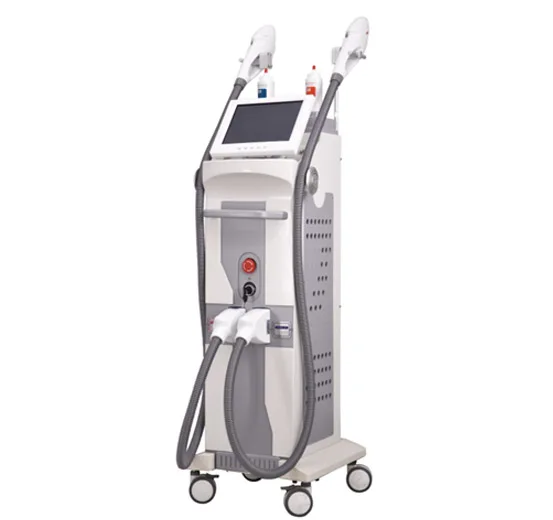 The machine that fitsPmise MF-05
Multifunction E-Light Platform Next noteHow 808nm Diode Laser Hair Removal Works
Why 808nm became the workhorse wavelength, what the growth cycle means for session planning, and the three settings that decide comfort and results. CatalogAll platforms
Twelve machines, one factory standard, full specifications.
Ready to spec your next machine?
Tell us the indication, your market and the certifications you need. Our export team replies with a configuration and quotation within 12 to 24 hours.