How 808nm Diode Laser Hair Removal Works
808nm diode laser hair removal is the industry workhorse for one unglamorous reason: it is the best compromise anyone has found between melanin absorption and reach. Here is what the wavelength really does, why the hair growth cycle rules your calendar, and how eyewear, a test patch, fluence, pulse width and cooling decide everything after that.
What the beam is actually aiming at
Point light at skin and you're playing odds with pigment. Melanin sits in two places that matter: spread thinly through the epidermis, packed densely into the hair shaft and the matrix that builds it. Treatment works only if the second heats faster than the first. That's the whole trick.
Our engineering archive is precise about the anatomy. Two structures need disabling, the isthmus around the bulge and the dermal papilla at the base, and neither absorbs much light. The real absorbers are the hair matrix and the shaft. They take up photons and conduct heat outward into the structures that regenerate hair. You never heat the target directly. You heat a neighbour and let it cook the target, which is why pulse width matters so much.
The physics is selective photothermolysis, set out by R. R. Anderson and J. A. Parrish in Science in 1983. Pick a wavelength your target absorbs better than its neighbours, deliver it in a pulse short enough to confine the heat, and you damage only what you meant to.
Why 808nm won the argument
The wavelength has to satisfy two demands that pull against each other. It must reach the follicular bulb, which for terminal hair means deep dermis and sometimes the fat below it, and it must still be absorbed by melanin when it arrives. Melanin absorption falls from red into the near infrared. Penetration rises. Where those two curves cross is the whole commercial argument for the diode.
Our archive puts the practical boundary near 800nm. Below it, light scatters heavily in the epidermis and is preferentially soaked up by epidermal melanin, so a pigment target sitting down in the dermis wants a longer wavelength. The archive also defines penetration depth honestly, as the distance over which a beam decays to 37 percent of what went in. The fraction that survives the trip is what you're actually dosing with.
755nm absorbs harder and pays for it twice, in scattering and in epidermal melanin that has no business being heated. 1064nm travels furthest and is kindest to dark epidermis, but melanin barely notices it, so you push fluence hard and the client feels every pulse. 808nm isn't the best at anything. It's the least bad at everything.
| Wavelength | Melanin absorption | Reach | Skin types commonly treated | The trade you make |
|---|---|---|---|---|
| 755nm alexandrite | Highest | Shallowest | I to III | Fast on fair skin, least margin on tanned skin |
| 808nm diode | Moderate | Reaches the bulb | I to V | General purpose; dark skin needs longer pulses, lower start energy |
| 1064nm Nd:YAG | Lowest | Deepest | I to VI | Safest on very dark skin, but high fluence, less comfortable |
Those ranges follow the StatPearls clinical summary. They describe common practice, not a guarantee, and each client's Fitzpatrick skin type still sets your parameters.
The growth cycle sets your calendar, not your sales script
Only follicles in anagen respond. The hair matrix is sensitive to laser treatment during active growth and not otherwise, and that one fact sits behind every course ever sold. A resting follicle carries less pigment and isn't doing anything worth interrupting. Every patch of skin holds a mixture of phases, and the mix differs by site, so legs behave differently from underarms. Nobody catches every follicle in one pass.
Published guidance lands on four to six sessions spaced four to six weeks apart, with maintenance every six to twelve months. Our device manuals set a hard floor of 28 days between sessions on the same area. The spacing isn't a payment plan. It's an attempt to meet each follicle while it happens to be growing.
Say reduction, not removal. US regulators clear these devices for permanent hair reduction, defined in 510(k) summaries as a long term, stable reduction in hairs regrowing measured at 6, 9 and 12 months after a completed course. Haedersdal and Wulf's systematic review found evidence for partial long term reduction after repeated diode and alexandrite treatment, and none for complete removal. Grey and white hair carries no melanin at all, so screen for it before you take the money.
Before any pulse leaves the handpiece
808nm is invisible. That one fact should change how you run the room.
Light between 700 and 1400nm passes through the outer structures of the eye and lands on the retina, concentrated by the eye's own optics roughly a hundred thousand fold on the way. Nobody sees it coming, so there's no blink and no flinch. A pulse that glances off a trolley rail does its damage in silence. The rule has no exceptions: protective eyewear rated for 808nm, on the operator, on the client, and on every observer, trainee or colleague in the room, for every pulse.
OSHA's hospital laser guidance is blunt about the matching part. Eyewear must carry its optical density and the wavelength it protects against, and it has to suit the laser actually in use. Goggles rated for 1064nm are not goggles rated for 808nm. Our device operation manual puts goggles for the operator and goggles or eye patches for the client into the pre-treatment sequence, before any parameter is set, and British Medical Laser Association guidance adds that patient eye protection may need to be fully occlusive.
Room controls are the cheap half of this.
- Door closed and access controlled the whole time the laser is armed.
- A warning sign on every door into the area while the laser is in use, covered or removed when it isn't.
- Nothing polished in the beam path: instrument trays, trolley rails, a phone face up on the couch, jewellery.
- Key out of the key switch and held by a named person when the room is unattended, which our manual requires anyway.
Three dials, wired together
Fluence. Our DL-07 808nm diode platform runs 2 to 80 J/cm² from one 300W handpiece with a 13mm by 15mm spot. Spot size matters more than operators expect: at a fixed wavelength, a bigger spot reaches deeper, because fewer photons scatter out the sides of the treated column.
Pulse width. 5 to 200ms. Thin hair has little thermal mass and answers to short pulses. Darker skin wants the same energy spread over a longer pulse, so the epidermis sheds heat while the bulkier follicle keeps accumulating it. This is your dark skin safety dial, and most operators are afraid to touch it.
Cooling. One number from our archive ends the argument about whether cooling is a comfort feature. At a given energy density, a pigmented follicle coagulates progressively at about a 100ms pulse. The epidermis, at that same energy density, reaches injury at about 99ms. One millisecond of margin. Without active epidermal protection you aren't running a safety window, you're running a coin toss. The DL-07 uses constant condenser contact cooling, holding the tip cold before, during and after every pulse, and that buys the margin back.
Now the step that gets skipped. You don't go hunting for the safe setting on the client's full treatment area. You find it on a test patch, in this order, every time:
- Fire a shot or two on your own forearm first, as our operation manual instructs, to confirm the machine delivers what the display claims.
- Patch the least conspicuous part of the area you intend to treat, at a lower energy than your target setting. BMLA guidance puts this at two to six shots and wants a separate patch for every body area, because a bikini line is not an upper lip.
- Check the immediate response, then wait. Our manual asks for an on-the-spot look within seconds of the shot; BMLA guidance normally requires 24 to 72 hours after the patch, following the manufacturer's stated interval. Take the longer of the two.
- Treat the full area only if nothing adverse appeared. A patch stays valid for around 24 months under BMLA guidance, unless the client tans, starts new medication, or you change technology or settings.
Some responses end the session rather than adjust it. Immediate greying or whitening of the epidermis. Blistering, or a wheal rising under the tip. Pain wildly out of proportion to the setting. Erythema still sitting there well beyond the brief window you'd expect. Any of those and you stop, or you come back at a materially lower fluence with a longer pulse.
The numbers below are our device manuals' starting points for that patch. They're input values for a test, not settings you may take straight to a full area:
| Site | Type I-II test-patch start | Type III-IV test-patch start | Type V test-patch start | Typical pulse width |
|---|---|---|---|---|
| Upper lip | 8 J | 7 J | 4 J | 30-40ms |
| Underarm | 10 J | 8 J | 5 J | 20-40ms |
| Arm or leg | 10 J | 8 J | 5 J | 20-45ms |
| Bikini | 8 J | 7 J | 4 J | 20-45ms |
Move in small steps once the patch has cleared. Our manuals cap each adjustment at 5 percent of energy or 5ms of pulse width. The endpoint you want is perifollicular papules with mild erythema and warmth. Shave first. Never fire over moles.
Stacking or in-motion, and what each does to the epidermis
Two techniques, two bets.
Stacking fires several pulses on one spot before moving on. Each lands on tissue that hasn't finished shedding the last, so effective exposure stretches and heat builds through the bulk of the dermis. It suits coarse, stubborn hair. It also spends the epidermis's recovery window, the exact window that 99ms figure tells you to protect. Stack on Type V skin without lengthening the cooling and you'll find out why our manuals list burns under long duration and fast firing on dark skin.
The in-motion technique inverts the bet. Drop the fluence, raise the repetition rate, and glide the cooled tip through overlapping passes so the treated volume climbs gradually toward damaging temperature while the contact window keeps pulling heat out of the surface. Our manuals give a starting recipe: 10Hz, around 20ms, power low, handpiece moving quickly, then raise power on the client's feedback. Comfort improves sharply and hot spots get rarer. The trade is time, and on very coarse hair, a slower result.
The DL-07 tip runs sliding mode without gel, which removes a consumable and several minutes per session. Keep the window clean and hold the handpiece perpendicular; a tilted one delivers less energy than the display claims.
Complications you should be able to name before a client does
Post-inflammatory hyperpigmentation is the one you'll meet most. Higher Fitzpatrick types and recently tanned skin carry the most risk, which is why our manuals ban sun exposure for 10 days before treatment and require sunblock for 10 days after. Erythema, oedema and a burning sensation are normal and brief. Blistering, crusting, dyspigmentation and, rarely, scarring are not. Those trace back to energy set too high, pulses too long, or a repetition rate that outran the cooling.
Paradoxical hypertrichosis is the strange one: hair growing thicker in or beside a treated area. It's uncommon. Among 7,381 laser hair removal patients reported in Aesthetic Surgery Journal in 2024, 25 (0.34 percent) showed an increase over baseline, and 24 of those 25 had been treated with an alexandrite laser rather than a diode. Upper arm was the most affected site, and daily sun protection went with significantly lower incidence. Warn about it anyway. A client told in advance has a question, not a complaint.
Some things aren't yours to solve. Hormonal drivers of excess hair growth and any undiagnosed lesion belong with a physician first. Our manuals also list photosensitising drugs, recent anticoagulants, pacemakers, pregnancy, keloid tendency and epilepsy as contraindications. Refer, and document the referral.
Duty cycle, bar life and the boring maintenance that protects both
A diode bar stack ages by heat, not by calendar. Clinics that skip the routine pay in output drift long before they pay for a dead handpiece.
Duty cycle is a physical limit, not a marketing figure. Our manuals pair pulse width with a maximum repetition rate: 5 to 20ms runs up to 10Hz, 25 to 40ms up to 5Hz, 45 to 100ms up to 2Hz, and anything above 100ms drops to 1Hz. Long pulses and fast firing are mutually exclusive. Plan throughput around that, not the 10Hz on the brochure.
The rest takes minutes. Start the cooling circuit 5 to 8 minutes before you fire anything and let temperatures settle near 18°C, keep the machine working between 18 and 26°C, and never run it dry. Use pure or distilled water only and change it every 30 days, even in a month the unit sat idle. Wipe the sapphire window after every client; a dirty window absorbs energy meant for the follicle and becomes a burn risk itself.
In our archive's spare parts list, the treatment handpiece costs several times more than any other replaceable module, well above the control board or LCD. The bar stack lives inside it. Five minutes of cooling discipline a day is the cheapest insurance in the room.
Want all of that on one sheet you can pin beside the machine? Ask us. Our engineering team keeps a consolidated DL-07 parameter and pre/post-care checklist: eyewear and room controls, the test-patch sequence and its abort criteria, starting energies by Fitzpatrick group and site, the pulse width to repetition rate table, the maintenance calendar. Distributors can request full specifications and a technical walkthrough with the same engineers. Both go through the Pmise engineering and specification contact page: tell us which one you want.
Evidence and further reading
Educational material for equipment buyers and operators. It is not medical advice, an operating protocol or a promise of clinical outcome.
- Anderson RR, Parrish JA. Selective photothermolysis: precise microsurgery by selective absorption of pulsed radiation. Science. 1983;220(4596):524-527
- Laser Hair Removal. StatPearls, NCBI Bookshelf: anagen sensitivity, session spacing, wavelength and skin type ranges, eye protection for operator and patient, complications
- OSHA eTool, Hospitals, Surgical Suite: Laser Hazards. Protective eyewear matched to the wavelength in use and marked with optical density, plus warning signs on all doors into the laser treatment controlled area
- University of Illinois Division of Research Safety, Laser Hazards and Control Measures: the 400 to 1400nm retinal hazard region, and near-infrared light focused about 100,000-fold onto the retina with no protective aversion response
- British Medical Laser Association, Treatment Guidelines for the Use of Laser and Intense Pulsed Light (May 2019): mandatory skin patch test of 2 to 6 shots, a separate patch per body area, a 24 to 72 hour wait before full treatment, patch validity, and occlusive patient eye protection
- Haedersdal M, Wulf HC. Evidence-based review of hair removal using lasers and light sources. J Eur Acad Dermatol Venereol. 2006
- Inoue Y, et al. What are the Factors That Induce Paradoxical Hypertrichosis After Laser Hair Removal? Aesthetic Surgery Journal. 2024
- US FDA 510(k) summary K180353, diode laser hair removal device: definition of permanent hair reduction measured at 6, 9 and 12 months
Put it to work
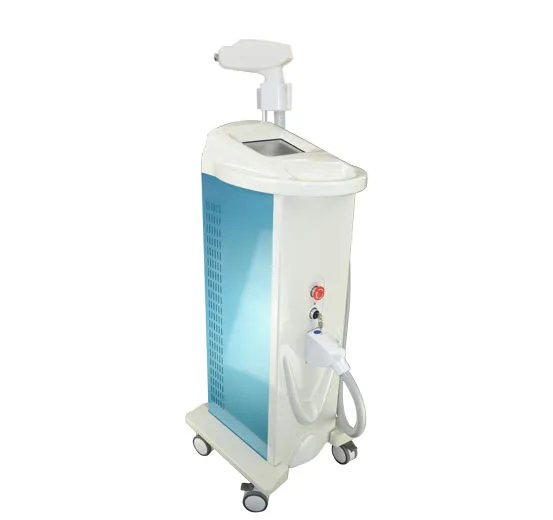 The machine that fitsPmise DL-07
808nm Diode Laser Hair Removal Next noteReading Fitzpatrick Skin Types Before You Treat
The I-VI classification, how it changes wavelength and fluence choices, and why conservative first sessions protect both the client and your reputation. CatalogAll platforms
Twelve machines, one factory standard, full specifications.
Ready to spec your next machine?
Tell us the indication, your market and the certifications you need. Our export team replies with a configuration and quotation within 12 to 24 hours.